Reading, Writing and Phonics
It is our intent at Becket Primary School to provide pupils with a high-quality education in English that will teach pupils to speak, read and write fluently so that they can communicate their ideas and emotions to others effectively. We want a culture where children can be confident in the art of speaking and listening, reading and writing to communicate effectively and to enjoy and be enthusiastic about writing and reading.
The curriculum is supported by the 3 I's: Intent, Implementation and Impact, and the subject overviews.
READING
We believe that becoming confident, independent readers will help children unlock the world around them, so we strive to create an environment where books are celebrated and staff and children have opportunities to share and discuss books together daily. Children at Becket will hear high quality stories read to them every day to develop their vocabulary, support their comprehension of texts and to inspire them to become avid readers themselves. The children will also read aloud to staff and each other in class and across the school in our reading assemblies to develop their reading fluency and independence as readers. Please see our newsletters to find out which books we are sharing in each class or have a read of the Becket Reading Spine below to see the full list of books that we enjoy reading in each year group. This spine is updated regularly as staff and children discover new books and authors that inspire or excite us.
PHONICS
We use Unlocking Letters and Sounds which was validated by the DfE in December 2021. Please see the parent information pack below for more information or do speak with your child's class teacher if you would like to know more. We run parent workshops at the start of each year as well.
At Becket, our preschool will focus on developing phonological awareness by teaching children sound discrimination, rhythm and rhyme, alliteration, oral blending and segmenting.
We begin teaching phonics in the first few weeks of term 1 in Reception and children make rapid progress in their reading journey. Children begin to learn the main sounds heard in the English Language and how they can be represented, as well as learning ‘Common Exception’ words for Phases 2, 3 and 4. They use these sounds to read and write simple words, captions and sentences. Children leave Reception being able to apply the phonemes taught within Phase 2, 3 and 4.
Phase 2 Actions, Images and Letter Formation
Phase 3 Actions, Images and Letter Formation
In Year 1 through Phase 5a, b and c, they learn any alternative spellings and pronunciations for the graphemes and additional Common Exception Words. By the end of Year 1 children will have mastered using phonics to decode and blend when reading and segment when spelling. In Year 1 all children are screened using the national Phonics Screening Check.
In Year 2, phonics continues to be revisited to ensure mastery of the phonetic code and any child who does not meet age related expectations will continue to receive support to close identified gaps.
For further details please see the Unlocking Letters and Sounds progression. ULS Progression Overview
To ensure no child is left behind at any point in the progression, children are regularly assessed and supported to keep up through bespoke 1-1 interventions. These include GPC recognition and blending and segmenting interventions. The lowest attaining 20% of pupils are closely monitored to ensure these interventions have an impact.
READING PROGRESSION
As children move through the early stages of acquiring phonics, they practise by reading texts which are fully decodable and closely tailored to their current phonic knowledge. In Reception, these are always selected for them by the teacher or teaching assistant. Books are changed frequently, whilst allowing sufficient time for reading and rereading at home.
Once children have a secure knowledge of the sounds taught and can blend words confidently, they access our numbered book banded reading scheme which has books from various published schemes and is designed to give children experience of a variety of reading genres. There are fiction and non-fiction books within each level to encourage the development of comprehension skills.
Following this, the children will move on to be considered 'free readers' and are encouraged to choose books from our class and school libraries that interest them. The books are colour coded to allow staff to make suggestions and guide the children towards books that are age-appropriate.
Comprehension is taught through individual, guided and whole class reading. In EYFS and KS1 this will be through small group or 1:1 reading using phonetically decodable books as well as discussions about their class books. In KS2 we have a two-week timetable which allows for whole class teaching, small group work and time for Reading for Pleasure. This variety allows staff to support the children to understand and reflect on the texts they are reading through the VIPERS skills of understanding vocabulary, making inferences, making predictions, being able to explain what they have read to others and the skill of summarising key events or information within a text.
WRITING
At Becket, our aim is for every child to write fluently, confidently and with pride. By combining rich, high-quality texts, explicit teaching, structured talk and high expectations, we empower children to see themselves as writers who can communicate effectively, creatively and purposefully across the curriculum and beyond.
We believe that all children should have meaningful opportunities to express their ideas, thoughts and creativity through writing. To support this, we use Ready Steady Write from Literacy Counts, a research-informed approach that develops confident, independent and successful writers with high aspirations.
The writing curriculum has been carefully designed to ensure that all children master the foundational skills of writing and learn to write fluently for a target audience with a clear purpose. Through engaging, vocabulary-rich texts, writing is taught as a structured, creative and purposeful process, enabling pupils to develop accuracy, fluency and their own distinctive writer’s voice.
Our Approach
It is considered that spoken language is the foundation of effective writing. Through structured talk, drama and vocabulary exploration, children learn to organise and express their ideas orally before committing them to paper. This ensures that writing is thoughtful, coherent and purposeful.
Key curriculum principles of writing include:
- Focus on sentence accuracy, grammar and punctuation
- Daily modelled and shared writing
- Regular, purposeful opportunities for editing and redrafting
- High expectations for presentation and pride in written work
- Inclusive teaching that enables every child to succeed
From Year 1, children are taught to self-assess and edit their writing using a purple pen, helping them to reflect on their work and make meaningful improvements. Editing and redrafting are embedded across all year groups and are an essential part of the writing process.
Writing Structure
Each year is broken down into a series of writing units which all follow a clear and consistent teaching sequence, supported by shared symbols across the school:
- Immerse / Jump in – engaging with high-quality example text and vocabulary
- Analyse / Look – exploring structure, language features, audience and purpose to build Writer’s Knowledge (Wise Owl)
- Plan / Say & Plan – organising and developing ideas
- Write / Say & Write – independent writing
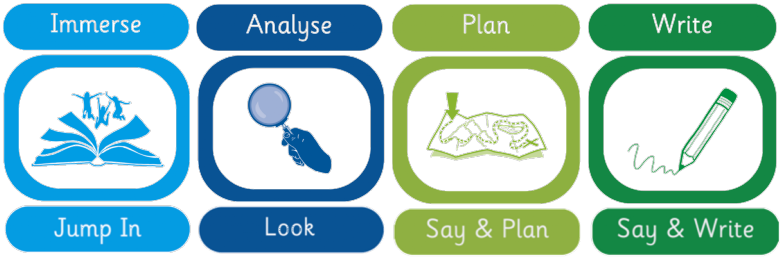
This structured approach ensures children understand how high-quality writing is constructed and how to apply these skills independently.
Grammar, Spelling and Handwriting
- Grammar is taught throughout the writing process, with a focus on grammar that is relevant and embedded within the text type being studied. Daily sentence accuracy sessions allow children to practise and apply grammar and punctuation in context.
- Spelling is taught daily using a clear teach, practise and test approach across the week. We use Spelling Shed to deliver our spelling curriculum in school, and children also access Spelling Shed at home to reinforce learning.
- Handwriting is taught explicitly from Year 1, with a focus on clear and legible letter formation. Joining is introduced in Year 2, and expectations for fluent, joined handwriting continue throughout all year groups.