Maths
Maths
Further details of progression throughout the school can be found on our Maths Curriculum Overview. The maths policy can be found here.
How you can help your child with maths.
Please ensure your child is practising regularly on Numbots (Y1 and Y2) and TTRockstars (Y2, Y3, Y4, Y5 and Y6), 10 minutes a day will ensure good recall and retention of the fluency facts. Children will sit the government's Multiplication Check Test (MTC) in Y4 and a secure knowledge of multiplication and division facts will help in many areas of mathematics, boost confidence and reduce maths anxiety. The links to these and other super learning resources you can use at home can be found below.
What does Maths look like at Becket?
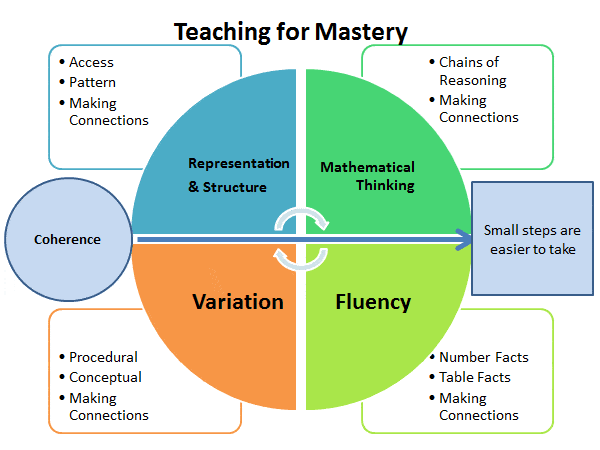
At Becket, we believe all pupils can be successful in learning mathematics and have a true enjoyment of the subject. Our school follows the 2014 National Curriculum for Maths with a focus on fluency, reasoning and problem-solving. When planning sequences of learning, we use a mastery maths approach informed by the NCETM and White Rose Maths. We are also supported in our teaching and learning by the Boolean Maths Hub.
Using a mastery maths approach means that children are taught mathematical concepts in small steps. This is because it is important that children master the first concept in a series before moving onto the next one. To help children understand and visualise the mathematical structures they are being taught, we ensure all children have access to a range of concrete practical resources, such as tens and fives frames, rekenreks and bead stings, which then link to pictorial representations such as part-part, whole and bar models and then the abstract written numbers. This enables children to develop a conceptual understanding of the structures underlying the mathematics.
The Kaleidoscope Multi-Academy Trust focusses on building strong Foundational Knowledge ensures the children develop the key skills they need to access mathematics in the wider world and for the next stage of their exciting mathematical learning journey.
Fluency
Addition and Subtraction
Fluency is taught using concrete resources first, making links between the amounts the children can subitise and then identifying the parts they can see which make up the full amount. This helps develop fluency in number bond addition and subtraction as children are able to break numbers down into smaller parts.
Children are then taught to link these amounts with the digits and number names we use to represent these amounts. Phrases such as ‘more than’, ‘less than’, ‘fewer’, ‘one more’, ‘one less’ are introduced in a talk rich environment supported by the BBC Number Blocks programmes. We follow the NCETM’s Mastering Number at Rec/KS1 for addition and subtraction facts in Reception, Y1, Y2 and Y3 to teach children different strategies for addition and subtraction, moving children away from counting on fingers to more efficient mental maths strategies. We also use the online maths game Numbots to enable children to regularly practise addition and subtraction using visual images and numbers.
Multiplication and Division
Children are first encouraged to look for and make patterns using concrete resources such a Numicon, toys, counters, moving onto pictures and then the symbol for those amounts. The concept of ‘sharing’ is introduced. The children then move onto exploring the relationship between amounts, looking at ‘What is the same?’ and ‘What is different?’ with sequences of numbers, looking for patterns on number lines, number tracks and number squares.
Children begin formal learning of multiplication and division facts in Y2 with 2, 5 and 10 times tables, then move onto 3, 4 and 8s in Y3 and 7, 9, 11 and 12s are taught in Year 4. We use the Systematic Times Tables method so by the time of the MTC children are fluent in fact up to 12 x 12. This is continued into Y5 and Y6 along with the NECTM’s Mastering Number at KS2 to ensure facts continue to be recalled with ease.
Online games such as Times Table Rockstars and Topmark’s Fact Families are fun and engaging ways to practise in school and at home.
Reasoning
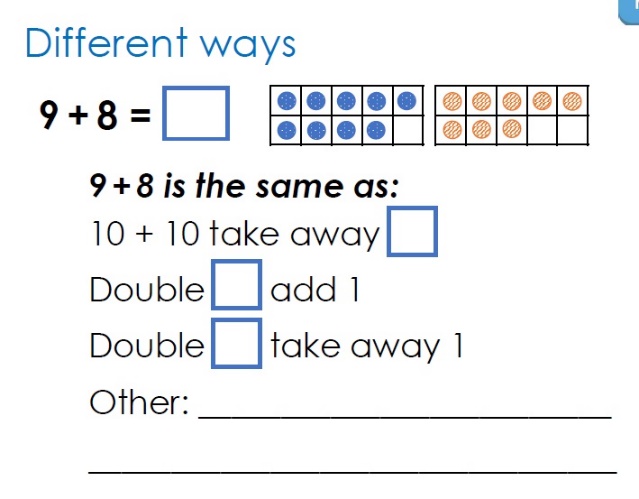
When teaching reasoning, children are encouraged to talk about the maths that they do from the very start of their learning journey. Developing knowledge of mathematical vocabulary is essential in providing the children with the words they need to explain the mathematics they are exploring. Specialist vocabulary now includes introducing the names of the parts of a number sentence, so the children can clearly explain their answer to questions such as, ‘What can you see?’ and ‘What do you notice?’ Children are encouraged to make links and use what they already know to help them. Reasoning is modelled by teachers ‘thinking aloud’ and in class discussion. Prompts such as low-stakes multiple choice quizzes using visual representations are used regularly to encourage children to share their ideas and methods of reasoning. Children are challenged to ‘Prove’ they have found the right answer or to ‘Show me’ why the others are incorrect. We use a range of reasoning resources, including those from I See Maths and the NCETM.
Problem Solving
When teaching problem-solving, we use resources from a range of sources, including NCETM, I See Maths and NRICH. NRICH is a wonderful website with many high-quality problem solving questions and puzzles for all ages. As with reasoning, teachers model their thinking out loud, choosing and naming strategies, such as those below, to help the children develop a range of problem-solving strategies. This helps build resilience and determination as the children have a starting point to use when faced with new and novel problems in mathematics.
- Trial and improvement
- Working systematically
- Pattern spotting
- Working backwards
- Reasoning logically
- Visualising
- Conjecturing
Useful Websites
TTRockstars – learn all your tables and division facts with regular practise.
Numbots – learn fluency in number bonds, addition and subtraction with regular practise.
NRICH – super reasoning and problem-solving questions.
TopMarks – loads of great games, including Hit the Button and Fact Families
Visnos – a variety of interactive maths models which can be used to explore multiplication, angles and time.
BBC Bitesize KS2 Maths – Games and revision activities and videos.
Maths is fun – lots of information and activities in all areas of maths.
White Rose Place Value Grid – Interactive place value grid for exploring place value and regrouping using counters.
White Rose Rekenrek – Interactive Rekenrek (bead abacus) for exploring number patterns and number bonds.